
Ideas behind
the loop.
Control, physical compute, and the cost of keeping hardware true.

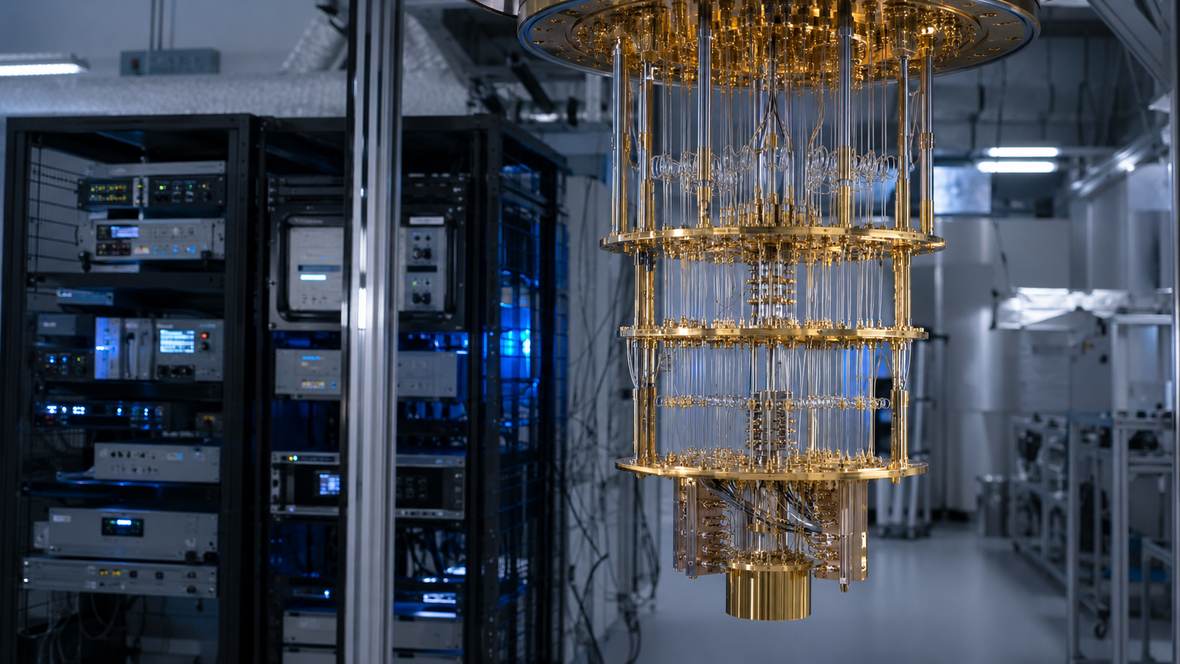
96 qubits, nine hours: the contract holds native drift
Fifty of fifty cycles on ibm_kingston through the public cloud, decision SUPPORTED under the registered rule. Drifting qubits gained 25.7 points of usable output; residual held at 0.27x drift; downtime was zero.
Read the pieceThird vendor, 156 qubits: the advantage widens as the problem grows
IBM Heron is the third commercial quantum processor to validate the loop live. The headline is 45.8% lower RMS error. The deeper result is the fixed-budget trend.
Read the piece
Hardware validation: what two quantum processors settled
Two processors, one retained-versus-reset ablation, one 107-channel closed loop, and the boundary of the framework drawn from both sides.
Read the piece
Three axes of advantage: what wins, when, and where
A method can win on measurement efficiency, optimization quality, or regulation under drift. Confusing the axes hides the real result.
Read the piece
The starved-budget regime
When the budget is tight enough, the method, not the math, decides whether the loop can finish.
Read the piece
Reproduce it yourself
The useful artifact is not a chart. It is the script that makes the chart on a fresh problem, with disclosed seeds and baselines.
Read the piece
When every measurement costs you
Some problems are slow because every objective evaluation is a physical event. The optimizer must be priced in measurements, not iterations.
Read the piece
The configuration is the state
Retaining the physical configuration changes the shape of the loop and the economics of the next decision.
Read the piece
Knowing when not to use it
Applicability follows from structure. Performance is measured on the customer plant, never forecast.
Read the piece