
← Writing
Results · 2026

Third vendor, 156 qubits: the advantage widens as the problem grows

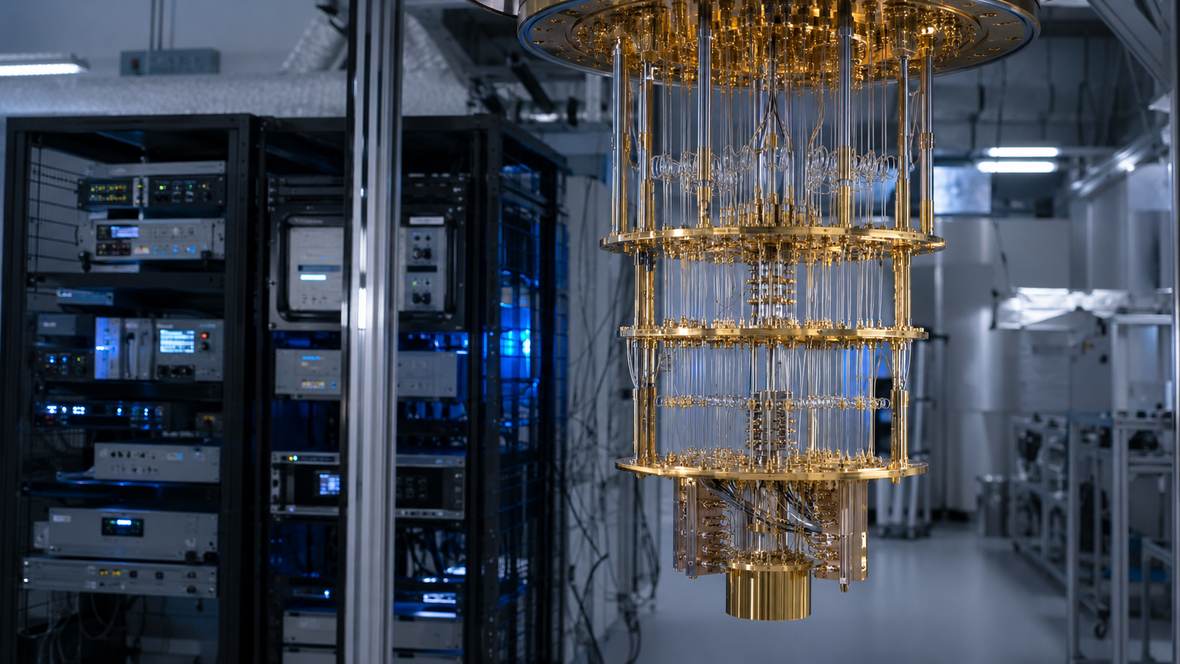
IBM Heron is the third commercial quantum processor to validate the loop live, this time at 156 qubits under a frozen measurement budget. The headline number is a 45.8% RMS error reduction. The result that matters more is the trend: at fixed budget, the advantage over estimator baselines widened as the problem grew.

What was run

On IBM Heron, a 156-qubit superconducting processor, the runtime regulated the full register under a frozen measurement budget: the same number of acquisitions regardless of problem size, disclosed in advance. Against the uncontrolled baseline the loop delivered a 45.8% reduction in RMS error. As with the first two vendors, the runtime was driven strictly as a hosted black box; nothing about the machine was special-cased.

The trend is the result

Holding the budget fixed and growing the problem, the advantage over estimator baselines widened from 1.7× to 2.5×. The arithmetic behind the trend is the entire thesis of this product: an estimator method pays a number of measurements that grows with the parameter count before it can take one step, while the loop pays one parallel acquisition per update at any size. Grow the problem at fixed budget and the estimator’s first step recedes; the loop’s cadence does not move.

Three vendors, one unmodified loop

Rigetti, IQM, and now IBM: three vendors, three control stacks, three noise environments, one unmodified production runtime. The 107-channel closed loop and the pre-registered retained-versus-reset ablation are documented in the previous results post; the evidence ladder and every claim tier live on the research page.

And past the hardware: a million channels against the live endpoint

The same loop, driven against the live production endpoint in simulation, holds a drift frontier flat from 64 to 1,048,576 channels at one parallel acquisition per cycle. The deployed per-actuator practice, granted oracle-exact corrections it never gets in reality, still falls behind by staleness arithmetic as size grows. The losing rows at small scale are published next to the wins, as always.

Run it yourself

Every claim that runs without hardware access reproduces from a free evaluation key, to 4,096 channels, from the public repositories. If a number does not hold on your machine, we want to know.

Run it on your workload →See pricing